
The Wire and the Cuddle Puddle
On early networked art, shared mis-digestion, and the strange beauty of mosh pits

Join me somewhere soon at a talk, a show, or a workshop → Upcoming Events
In 1982, Robert Adrian linked sixteen cities in a 24-hour global relay. Artists faxed from Istanbul, slow-scanned TV from Vancouver, dialed in poetry from Florence. The work wasn’t the image, or the sound, or even the message. It was the space between, the relay. “Networked art,” Adrian wrote, “would be defined by exchange—taking place in the space between machines, only when the machines were on.”
This idea is still radical. That art isn’t what’s made, but what’s passed. That the work lives in the transmission, not the origin, not the destination, but the passing on.
The same current runs through Galloway and Rabinowitz’s “Mobile Image” projects. Their “Satellite Arts Project” (1977) and “Hole in Space” (1980) weren’t just technical marvels, they were emotional experiments in long-distance intimacy. People wept, danced, flirted, froze. When strangers in New York saw strangers in LA in real time, unannounced, unfiltered, it wasn’t spectacle. It was connection. A communion.
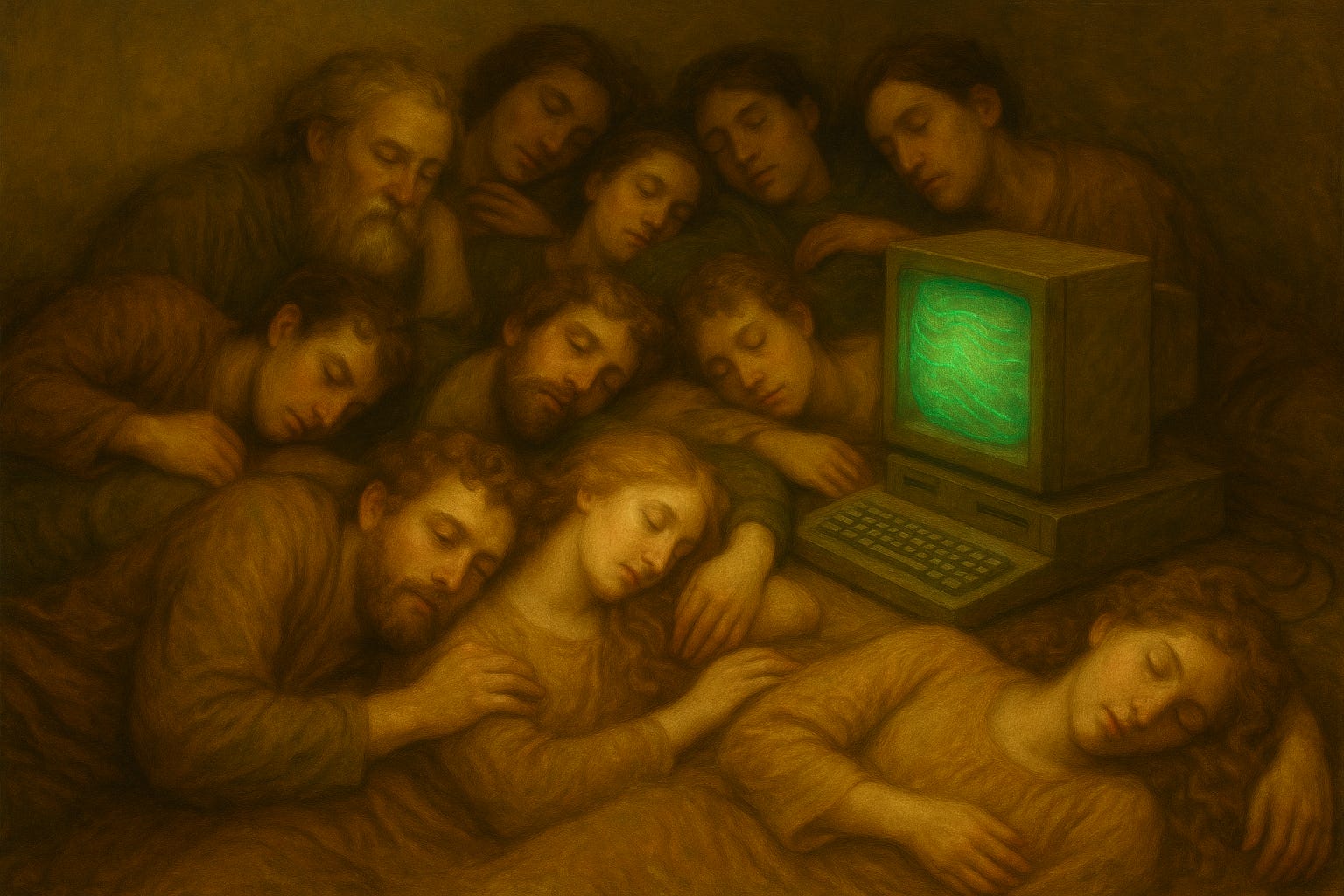
That hunger (to be connected, to stretch beyond one’s self) is everywhere in early networked art. And not just for access. For immersion. For something that cracks the shell of individualism and brings us back to the soup. The primordial party. The digital bacchanal.
In their 1984 manifesto for “Electronic Café”, Galloway and Rabinowitz wrote: “We must create at the same scale as we can destroy.” They saw the network not just as medium, but as a place to re-socialize, to miscommunicate, to meet.
Even Bernard Stiegler, decades later, still clung to the promise. “Digital networks,” he wrote in Taking Care of Youth and the Generations, “could have become the true instruments of a new enlightenment.” He saw connectivity as care. As potential.
The wire we once dreamed, the connection we thirsted for, became endless scroll. The satellite kiss turned platform dependency. In the fissures of doom swiping, the same insight shines trough: It’s likely that what we longed for wasn’t information (not the perfect relay of datum) but approximation. The sharing of weirdness. The relief of mis-digestion.
That’s what I’ve tried to reclaim with Building the Strange Choir, a participatory workshop/performance where participants fine-tune voice models on their own personal strangeness (receipts, eulogies, cringe diaries) and feed them into a text-to-speech-to-text feedback loop. Twelve machines start talking to each other. Then the humans join in. Soon, a glitchy fugue emerges. Half-mirrored syntax. Mispronunciations. Errant joy.
It’s not harmony. It’s chorus. Each voice struggling to make itself heard. Failing. Passing the hot potato of intention. The result is something messier (and more intimate) than any polished solo.
This is the aesthetic of the networked happening: not a clean stream, but an orgy of half-understood utterances. A mosh pit of meaning. Milan Kundera called it “variation” rather than adaptation: a gesture not of fidelity but of play. “A variation,” he wrote in The Art of the Novel, “evokes no model, respects no canon. It is the aesthetic of echoes.”
The remix isn’t derivative. It’s devotional. In this sense, networked art is less about communication and more about communion. Not about clarity, but about proximity. About leaning close enough to hear someone else fail to say something true. And laughing. Or crying. Or mishearing it into something new.
What we wanted from the network was not the feed, but the feeling. Not efficiency, but entanglement. The work happens in the transmission. In the delay. In the fact that we’re trying, together, to say something we don’t yet have the words for. Maybe that’s what connection was always for. Not the message. The mosh pit. The mess.