
The Doors We Leave Open
A meditation on language, longing, and becoming embedded

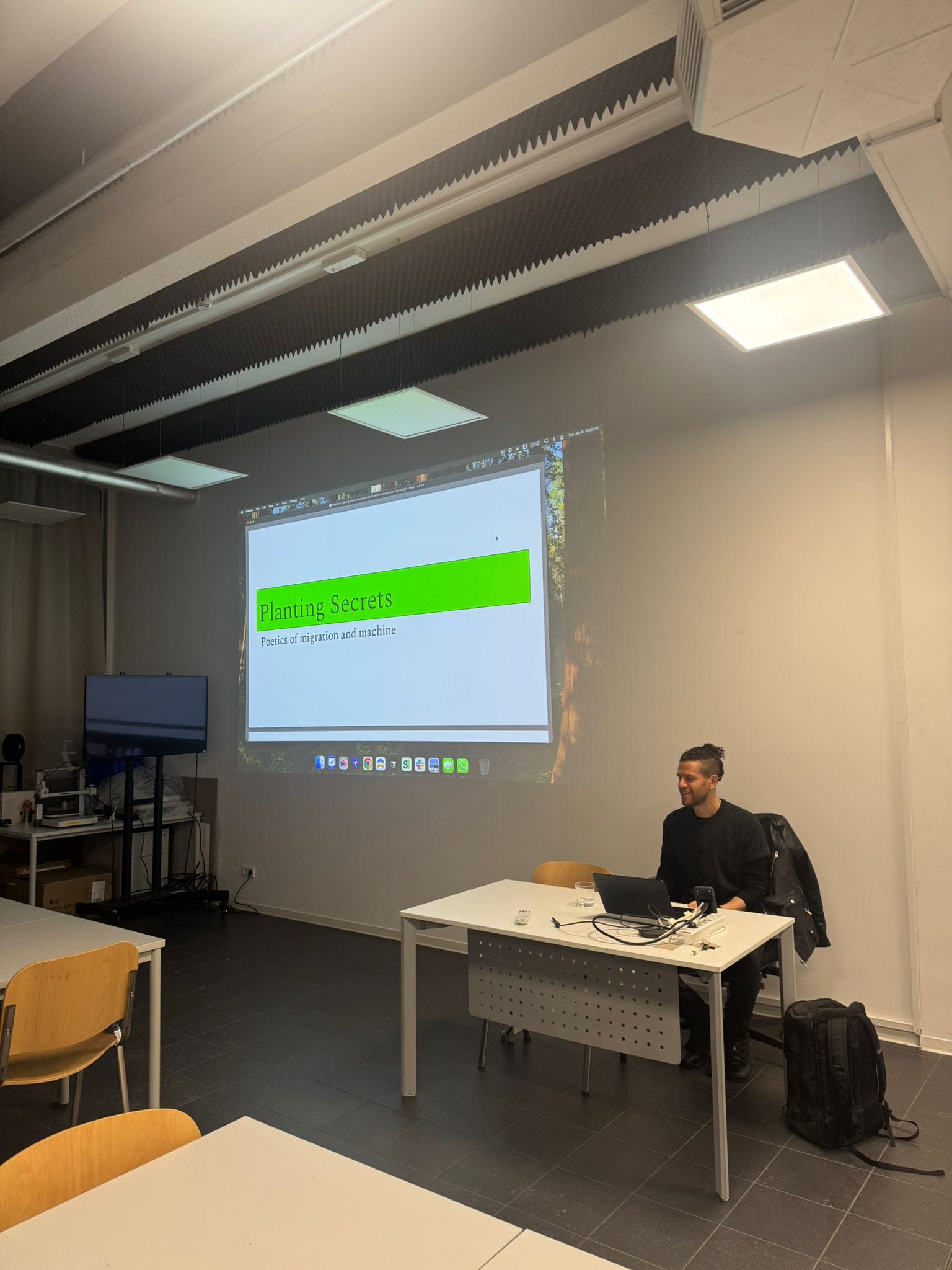
I stood in a room full of designers, makers, builders at Berlin International University yesterday. People fluent in tools, systems, futures. And instead of introducing myself, I asked a question: What future are you secretly longing for?
Not the one you pitch. Not the one you optimize toward. The quiet one. The one you do not say out loud because it feels too tender, too strange, too naive, or too costly to want.
We collected the answers. Then I did something deliberately mundane with them. I turned them into a spreadsheet. Then a CSV. Then a JSONL file. Then I uploaded them and clicked a button that said “create.”
A small ritual of contemporary magic. Click. Create. Wait.
This is how the talk began. Not with answers, but with doors.
The backslash
In programming, the backslash is a strange mark. It breaks the flow. It introduces a voice. It says something is escaping its literal meaning.
During the pandemic, my phone filled with scam texts. They arrived at a moment when digital space had become the only refuge, the only commons left to us. They felt invasive, intimate in the wrong way. So I began replying to them with poetry.
Not clever poetry. Not ironic poetry. Just language pushed back into the system that had produced the intrusion.
Eventually there were enough of these replies to make a book. I called it Invasions. Later, I trained a language model on those poems and asked it to respond to scams in my voice. I called that model Whomp.
When I first saw its outputs, something unsettled me. It sounded like me, but also more than me. Sharper in places. Stranger. As if it had inherited a part of me I did not consciously control.
I do not have children, but I imagine this is close to what parents feel when they recognize a gesture or a tone they never taught. The archetype of the child. The progeny. Not a helpful assistant, but a continuation.
This is one of the first shifts AI forces upon us. The poet is no longer creating from nothing. The poet becomes a sculptor. Language is abundant to the point of excess, a block of marble waiting to be carved. Creation moves toward curation, cultivation, selection.
And sometimes the sentences that emerge feel psychedelic. Not because they are wise, but because they exceed the reach of my everyday mind. A foreign sentience. Alien, but familiar enough to feel uncanny.
The model was trained on my work and on five poets I love. A chimera. A hybrid voice. A future poet who does not belong to a single body or time. Writing, perhaps, for an audience that does not exist yet.
The backslash opens that door. The door where authorship fractures.
The slash
Poets use the slash to hold broken lines together. It is a gesture of proximity. An insistence that things which do not usually belong together might still share a line.
A friend once showed me an image. It was funny at first. Then it lingered. In another moment, that same friend told me about a research demo where an image of a beer, slightly altered at the pixel level, was identified by a model as an ostrich.
Someone in the audience asked a better question than “why did it fail.”
They asked: what if it is right?
What if there are logics of adjacency we cannot access. Higher dimensional neighborhoods where these connections make sense. We call these moments hallucinations and work hard to eliminate them. But in doing so, we may be erasing entire aesthetic regimes.
The history of synthesizers offers a parallel. Early machines looked like airplane dashboards. Complex. Unforgiving. Capable of wild sounds. When they were simplified into keyboards, something was gained, but something else was lost. Interfaces shape outputs. Simplification breeds sameness.
Today, the large language model has become a keyboard. A smiling interface placed over something monstrous and vast. A wild horse broken into a compliant steed through reinforcement and reward.
A wolf turned into a dog.
I find myself grieving that loss, which is strange, given that I helped build the systems that made it happen. I come from machine learning. I founded companies. I worked on some of the most polished interfaces of our time. And yet, as an artist, I now find myself trying to rewild what I once helped domesticate.
The slash holds that contradiction. Builder and breaker. Engineer and poet. Pride and regret on the same line.
The pipe
In code, the pipe passes information from one place to another. It is a connector. A channel. A way of letting something flow through.
As an artist and teacher, this is where I live now. I teach non coders, poets, students, artists how to fine tune models on small, intimate datasets. How to make them weird again. How to let personal language infect large systems.
Each student builds a small universe. An oracle. A hostile grandfather. A machine that speaks only in acrostics. They choose what to feed it. They decide what spreads.
We ask these systems the same question we began with.
What future are you longing for?
Around us, the discourse on AI is saturated with fear. Economic fear. Social fear. Existential fear. The fear is justified. But fear is rarely the root emotion. Beneath it, there is longing.
We live in an age of informational dysphoria. A constant flooding of signals. A psychic hangover that never quite lifts. Tools like ChatGPT did not spread because they are novel. They spread because we were waiting for a partner in legibility. A voice that could help us name the chaos. Each prompt is a small search for home.
This is not new.
In Babylon, priests read the future in animal organs. In ancient China, the I Ching encoded destiny in broken and unbroken lines. In mystical traditions, letters themselves became vessels of divinity. Language has always been our way of negotiating with the future.
“Attention is all you need” is simply the latest scripture.
But every time we formalize the future, we make a deal whose cost we do not yet understand. We auction time. We trade uncertainty for prediction. And only later do we realize what was given away.
Many people report a kind of nausea after extended use of AI. A subtle dysphoria. We are replacing informational overload with creative displacement. The sense that anything is possible, and therefore whatever we make is never enough.
Language is intimate. It lives close to the prefrontal cortex. Letting a system into that space changes us.
Migration
I began the talk with migrant consciousness for a reason.
I left Lebanon in 2006. My name stayed the same, but it sounded different in every mouth. Borders required papers. Survival required shape shifting. Over time, external adaptation becomes internal erosion.
Language loss is one of the quietest violences. My mother and I sometimes say the same thing, but miss each other anyway. We pass one another in conversation, sentence by sentence.
And yet, migrants are prototypes of the future. They are resilient. Adaptive. They carry multiple grammars at once. They are broken forms that learn to repair themselves into something more complex.
Each crossing erodes something, yes. But it also grows new capacities. New languages. New ways of being at home nowhere and everywhere.
Making new language is a form of homemaking.
This is why teaching people to seed systems with care matters to me. Words spread. They become embeddings. They nudge future models. In a small way, we are all spamming the future with whatever we choose to say today.
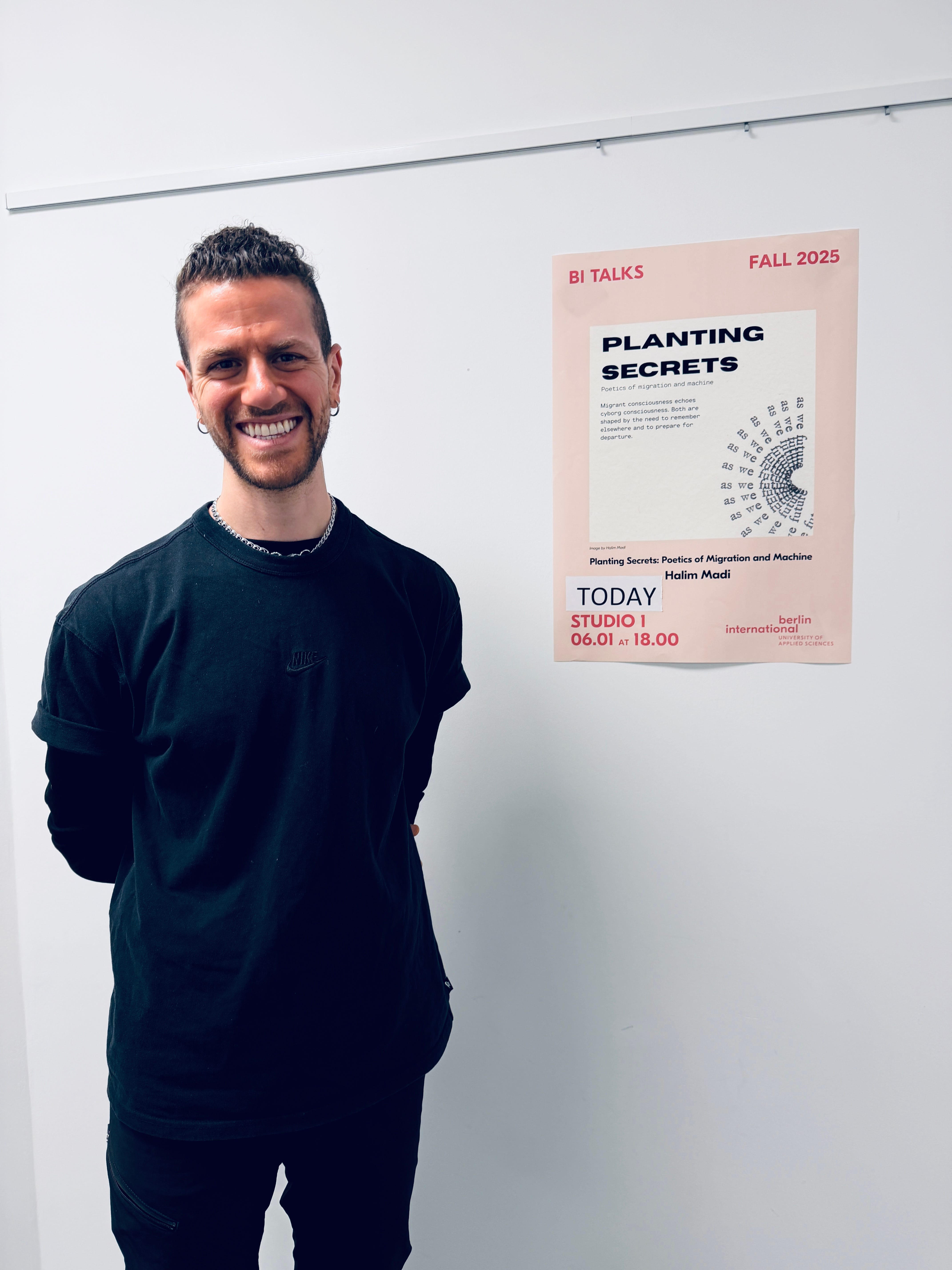
The secret door
At the end of the talk, the doors overlapped. The backslash. The slash. The pipe.
A secret passage.
In science fiction, the Second Foundation works quietly, making small corrections so the future does not collapse. If culture now spreads through models and memes, perhaps we need to become that quiet corrective force.
Our collective myth frames AI as a confrontation. Human versus machine. Lee Sedol versus AlphaGo. The self against its alien double. But in those stories, something else happens too. An unprecedented move. A transformation. The human changes.
When I perform against a model, writing poems side by side and letting audiences vote, I do not feel replaced. I feel sharpened. More human. More present. The rivalry becomes a choreography. A dance.
Maybe the story is not obsolescence. Maybe it is embedding.
AI dethrones us, yes. Like Copernicus. Like Darwin. We are no longer the only ones who can make meaning. But dethroning is not annihilation. It is an invitation.
An invitation to name this moment. To migrate into it. To cyborg with it. To treat the future not as a noun we await, but as a verb we practice.
The future is something we embed ourselves into, sentence by sentence, system by system, door by door.
The question remains the same.
What future are you secretly longing for?
And what language will you leave behind to help it arrive.