
The Combinatorial Occult
Jackson Mac Low, code as spell work, and the architecture of power

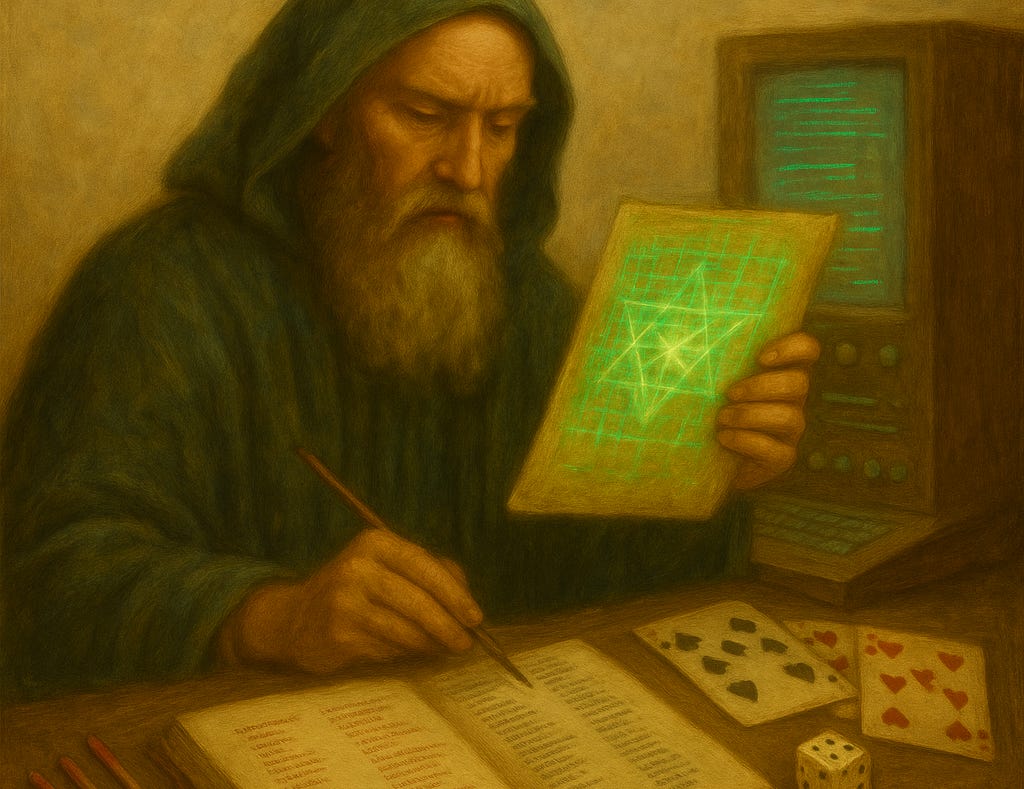
Today I want to talk about poetry, power, and systems. About language that doesn’t just say something but does something.
Let’s begin with Jackson Mac Low’s Light Poems, an under-read archive of poetic method and madness. In an exchange with Jerome Rothenberg (linked here), Mac Low shares the meticulous generative process behind the poems: combinatorial chance operations using letters, playing cards, made-up taxonomies of light, and the dedicatee’s name.
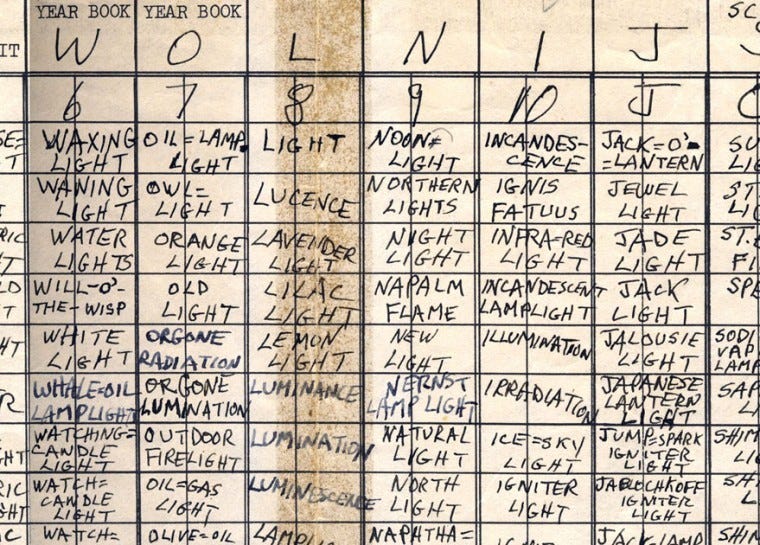
“Each of the 14 columns of the list of kinds of light accords with one of the 14 different names of denominations of playing cards … and with one of the 14 different letters in Iris and my names.”
—Jackson Mac Low
There’s something uncanny about this. Not random, not purely “free.” A Golem logic.
A private spell. A code.
Why does this move us?
Why are we fascinated by poems like these, or by projects like the Whitney Museum’s CODeDOC where artists share code as the art itself, before the visuals even load?
I think it’s because these works trigger a very specific kind of delight: what I’ll call the combinatorial occult. That pleasure of encountering something structured yet mysterious, systematized yet alive.
Here’s what I think we respond to:
I. A Peek Inside a Mind
We’re not just reading the work, we’re watching its machinery. The scaffolding, the gears. We get access to a strange intimacy: How a mind filters the world, how chance becomes choice, how a private logic becomes a public language.
In Light Poems, Mac Low doesn’t just write poems, he generates them with a system. We see the magician’s table, not just the dove.
II. The Presence of a Code
There’s a thrill in realizing the work was made by a system. Like finding a cipher key at the back of the book.
In code-based art, the code is both canvas and brushstroke. In procedural poetry, the constraint becomes an engine. It’s not just expressive, it’s architectural.
This is what Peter Sloterdijk described in relation to Foucault and Wittgenstein: not just describing language, but producing the conditions for thought. A logic that structures, and is structuring.
III. A Sense of Adventure in the Discovery
Finding the system is a kind of hero’s journey. You go from confusion → curiosity → illumination. You realize Cubism was a flattening of 3D into the 2D plane, that a poem is a machine for producing affect under constraint or that code isn’t just technical. It’s a structuring cosmology.
There’s a nerdy awe in that. The pleasure of cracking something. The joy of the algorithmic sublime.
Systems as Aesthetic Power
There’s an archetype we’re circling here: the artist as architect, or maybe as villain. The one who builds the maze. Who controls the rules. Who structures the system that the rest of us have to live inside.
Think Moriarty (the criminal mastermind), Ozymandias in Watchmen (controlled apocalypse), The Joker (chaos as design), Foucault’s Panopticon or even AI models trained on private archives, silently shaping output.
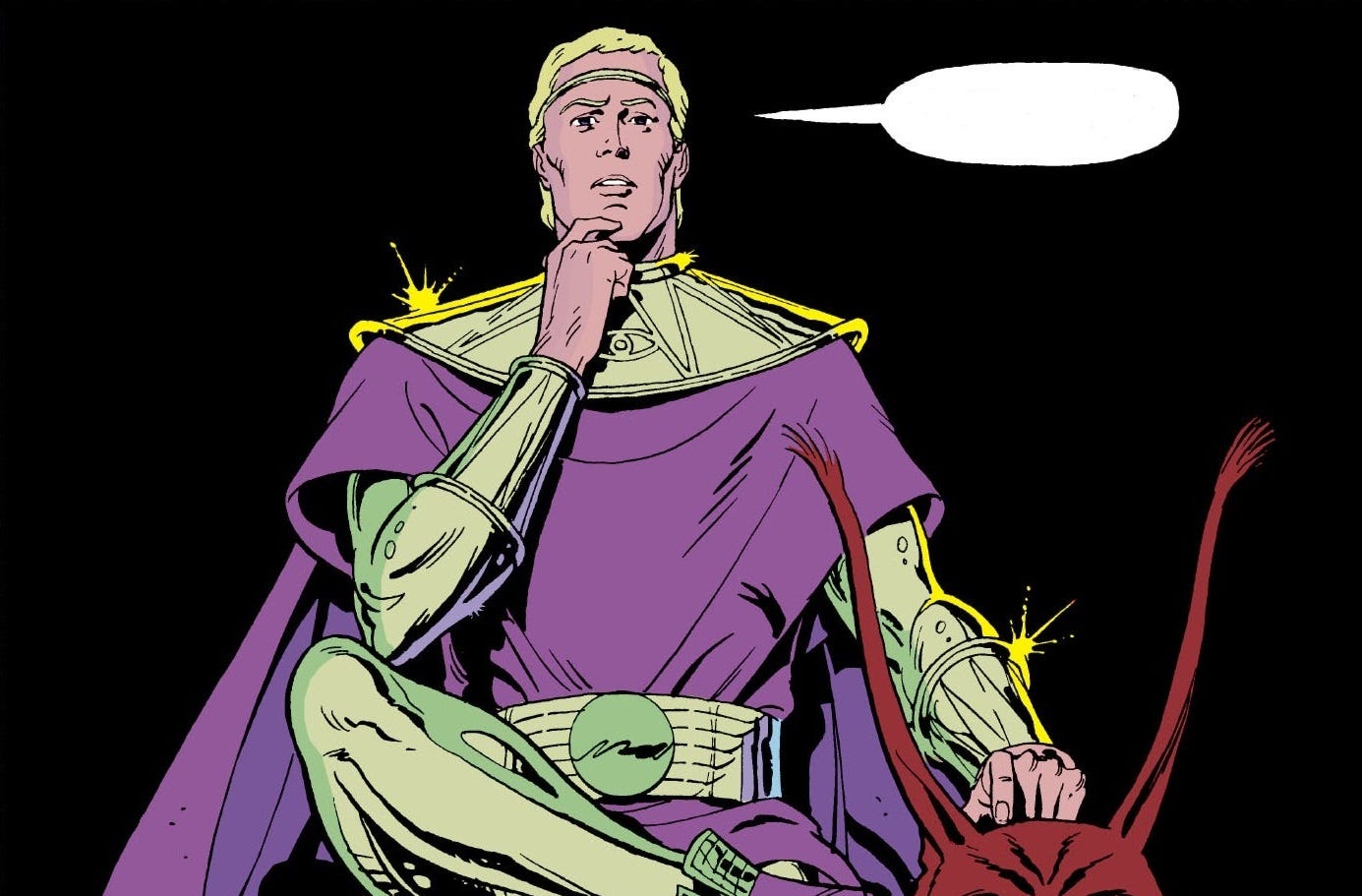
These figures blend obsession, control, and elegance. We fear them but we also respect them. Because they’ve mastered the system. They’ve become not just players in the game, but designers of it.
And isn’t that, on some level, what we want as artists? Not just to express but to structure the conditions for expression? Not just to make but to make systems that make?
From Light Charts to Code Canvases
Mac Low’s 14-column light chart isn’t so different from a generative algorithm. From the procedural art in CODeDOC. From a neural net tuned to outputs that feel human.
“Even the ‘strictest’ following of given methods has always been for me crisscrossed with artistic choices, often ones made at liminal and subliminal levels.”
—Mac Low
The system is the stage, but the artist is still dancing. The control is real but the gesture is still alive.
This matters now because we live in an age where generative systems are everywhere, because AI writes poems and plots and code, because we’re all becoming system designers. And maybe we’re realizing that the power to control isn’t just a technical feat, it’s an aesthetic lure. That control can be sexy. That systems can seduce.
And so we circle back to Mac Low’s light chart, to the combinatorial occult, to the coded poetics of modern life. The art isn’t just what’s written it’s how it was written, and who owns the logic.
Further Reading / Wandering
Mac Low & Rothenberg’s exchange on Light Poems: Jacket2 article
Code as Canvas, Brush, and Palette: Whitney Museum’s CODeDOC
Sloterdijk on structured thought: Spheres, The Art of Philosophy